
La Bibliothèque d'Applications présente des modèles construits avec COMSOL Multiphysics pour la simulation d'une grande variété d'applications, dans les domaines de l'électromagnétisme, de la mécanique des solides, de la mécanique des fluides et de la chimie. Vous pouvez télécharger ces modèles résolus avec leur documentation détaillée, comprenant les instructions de construction pas-à-pas, et vous en servir comme point de départ de votre travail de simulation. Utilisez l'outil de recherche rapide pour trouver les modèles et applications correspondant à votre domaine d'intérêt. Notez que de nombreux exemples présentés ici sont également accessibles via la Bibliothèques d'Applications intégrée au logiciel COMSOL Multiphysics® et disponible à partir du menu Fichier.
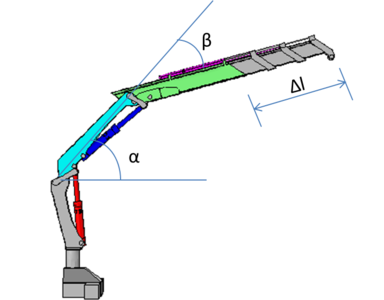
This app demonstrates the following: Using the knob form object Updating the geometry by rotating a knob Provides info if the results are above or below certain critical values Many trucks are equipped with cranes for handling loads and such cranes have a number of hydraulic ... En savoir plus
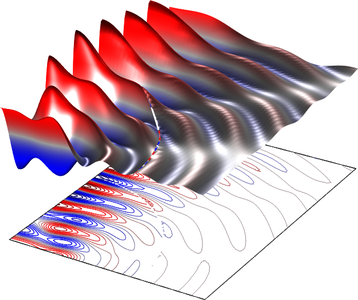
An axisymmetric model of a rigid piston in an infinite baffle is used to exemplify the Exterior Field Calculation feature of the Acoustics Module. The radiation results provided by the COMSOL Multiphysics® software are compared to analytical results for the on-axis radiation ... En savoir plus
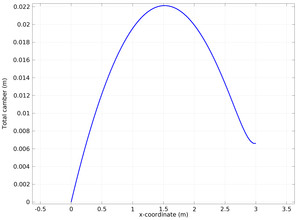
In this example you will build and solve a 3D beam model using the 3D Beam interface. This model shows how a thermally induced deformation of a beam is modeled. Temperature differences are applied across the top and bottom surfaces as well as the left and right surfaces of the beam. ... En savoir plus
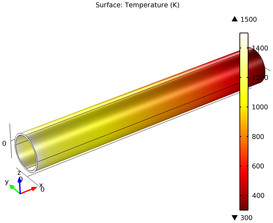
The heat distribution in a hollow pipe, whose ends are held at two different temperatures, is studied. The outside surface is assumed to be thermally isolated and the inner surfaces have radiation boundary conditions. The role of convection in the heat transfer is taken to be ... En savoir plus
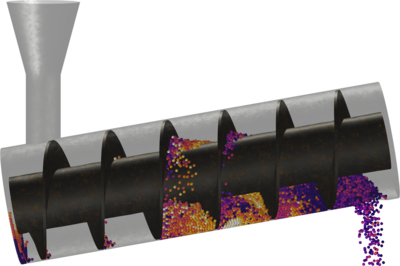
This model demonstrates the transport of grains using a screw conveyor. The grains enter the conveyor through a chute and are transported over an incline by a rotating screw. This model also demonstrates how to build and run a model method that evaluates the mass flow rate. En savoir plus
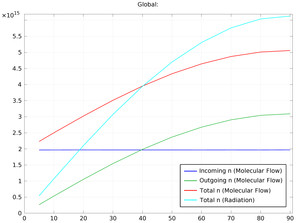
This model computes the particle flux, number density and pressure on the surface of a plate that rotates in a highly directional molecular flow. The results obtained are compared with those from other, approximate, techniques for computing molecular flows. En savoir plus
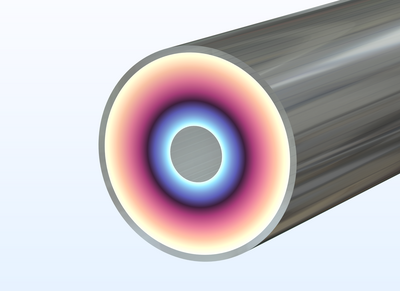
This example demonstrates how to compute transmission line parameters such as series resistance, series inductance, shunt conductance, and shunt capacitance per unit length using the predefined Transmission Line RLGC Parameters multiphysics interface. The demonstration also includes the ... En savoir plus
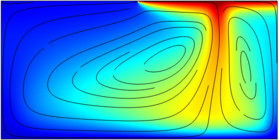
Density variations can initiate flow even in a still fluid. In earth systems, density variations can arise from naturally occurring salts, subsurface temperature changes, or migrating pollution. This buoyant or density-driven flow factors into fluid movement in salt-lake systems, saline ... En savoir plus
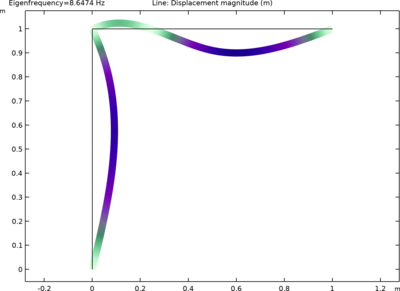
In this model, you build and solve a 2D beam model using the 2D Structural Mechanics Beam interface. This model describes the eigenfrequency analysis of a simple geometry. A point mass and point mass moment of inertia are used in the model. The two first eigenfrequencies are compared ... En savoir plus
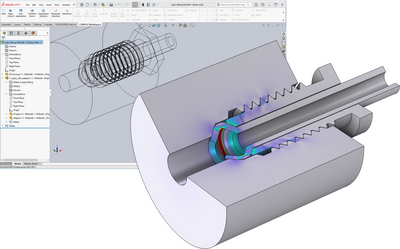
This tutorial model shows the setup of a 2D axisymmetric stress analysis, through contact, of a 3D threaded pipe fitting. The example involves synchronizing the 3D SOLIDWORKS® geometry and selections, which specify the faces in contact, with the 2D geometry in COMSOL ... En savoir plus


