
La Bibliothèque d'Applications présente des modèles construits avec COMSOL Multiphysics pour la simulation d'une grande variété d'applications, dans les domaines de l'électromagnétisme, de la mécanique des solides, de la mécanique des fluides et de la chimie. Vous pouvez télécharger ces modèles résolus avec leur documentation détaillée, comprenant les instructions de construction pas-à-pas, et vous en servir comme point de départ de votre travail de simulation. Utilisez l'outil de recherche rapide pour trouver les modèles et applications correspondant à votre domaine d'intérêt. Notez que de nombreux exemples présentés ici sont également accessibles via la Bibliothèques d'Applications intégrée au logiciel COMSOL Multiphysics® et disponible à partir du menu Fichier.
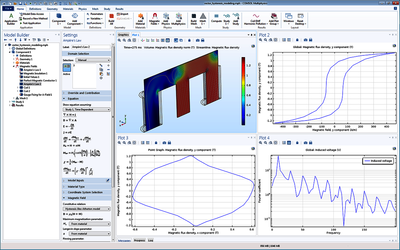
This tutorial is a benchmark model that reproduces the Testing Electromagnetic Analysis Method (TEAM) Problem 32, which evaluates numerical methods for the simulation of anisotropic magnetic hysteresis. A hysteretic three-limbed laminated iron core is subject to a time-varying magnetic ... En savoir plus
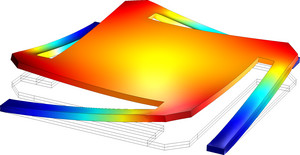
One method of creating spring-like structures or inducing curvature in thin structures is to plate them to substrates that are under the influence of residual stresses. The plating process can control this stress even for similar materials. One such device is the electrostatically ... En savoir plus
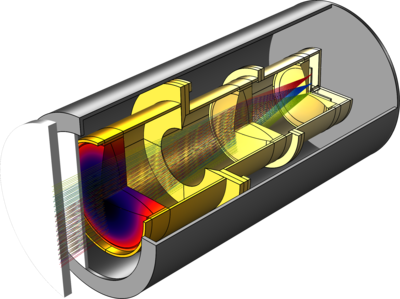
This model demonstrates an integrated structural-thermal-optical performance (STOP) analysis of an optical system. The Petzval Lens tutoral is used as the basis for this model, together with a simple barrel geometry The isothermal model performs a Parametric Sweep over several uniform ... En savoir plus
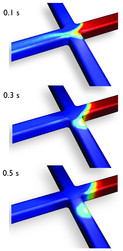
This application presents an example of pressure driven flow and electrophoresis in a 3D micro channel system. Researchers often use a device similar to the one in this model as an electrokinetic sample injector in biochips to obtain well-defined sample volumes of dissociated acids and ... En savoir plus
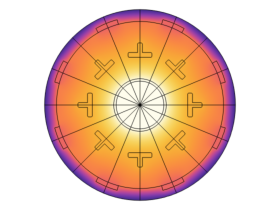
This model illustrates an application that maximizes surface-to-surface radiative fluxes and minimizes conductive heat fluxes. A thermo-photo-voltaic (TPV) cell generates electricity from the combustion of fuel and through radiation. The fuel burns inside an emitting device that ... En savoir plus
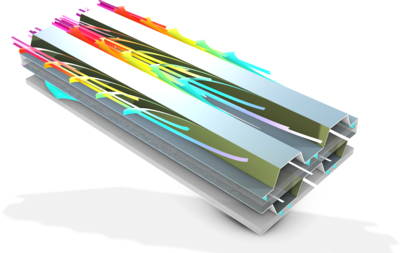
This model defines a zero-gap alkaline water electrolyzer, where oxygen and hydrogen gas are evolved in porous gas diffusion nickel felt electrodes, placed adjacent to a porous separator (diaphragm). The geometry defines a unit cell of an electrolyzer stack, in turn comprising two full ... En savoir plus
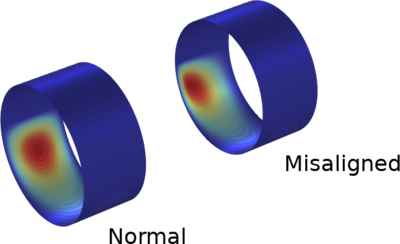
In this example, a rotor supported on two hydrodynamic bearings is analyzed. An eccentric disk located between the two bearings causes the rotor to whirl. One of the bearings is misaligned with the axis of the rotor. The Beam Rotor with Hydrodynamic Bearing interface in the ... En savoir plus
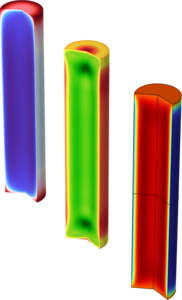
A steel billet is quenched in oil from its austenitic state. A 2D axisymmetric model is used to simulate the coupled problem of austenite decomposition, heat transfer, and solid mechanics. During the quenching process, the austenite decomposes into a combination of ferrite, pearlite, ... En savoir plus
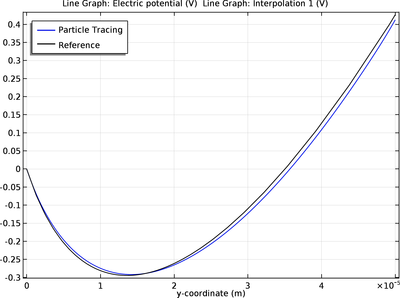
When electrons are emitted from a heated cathode in a plane parallel vacuum diode, they contribute to the space charge density in the diode, which in turn affects the electric potential distribution. If the potential difference between the cathode and the anode is not sufficiently large, ... En savoir plus
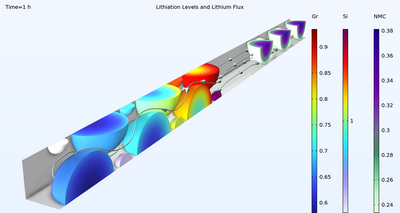
This model describes the behavior of a lithium-ion battery unit cell modeled using an idealized heterogeneous three-dimensional geometry. In contrast to the typical homogenized approach for describing porous electrodes, heterogeneous models define the actual shapes of the electrode ... En savoir plus