
La Bibliothèque d'Applications présente des modèles construits avec COMSOL Multiphysics pour la simulation d'une grande variété d'applications, dans les domaines de l'électromagnétisme, de la mécanique des solides, de la mécanique des fluides et de la chimie. Vous pouvez télécharger ces modèles résolus avec leur documentation détaillée, comprenant les instructions de construction pas-à-pas, et vous en servir comme point de départ de votre travail de simulation. Utilisez l'outil de recherche rapide pour trouver les modèles et applications correspondant à votre domaine d'intérêt. Notez que de nombreux exemples présentés ici sont également accessibles via la Bibliothèques d'Applications intégrée au logiciel COMSOL Multiphysics® et disponible à partir du menu Fichier.
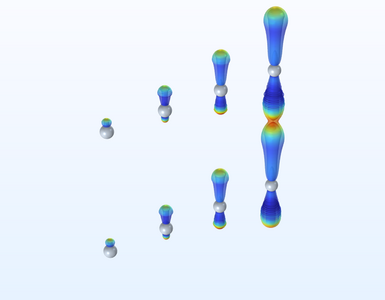
This model simulates the initiation of streamers from suspended metal particles, their propagation under a high electric field, and their subsequent merging. The discharge current flows into the metal particles, which are maintained at equal potential. These suspended particles enhance ... En savoir plus
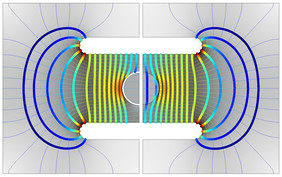
The thin low permittivity gap boundary condition is meant to approximate a thin layer of material with low relative permittivity compared to its surroundings. This boundary condition is available for electrostatic field modeling. This example compares the thin low permittivity gap ... En savoir plus
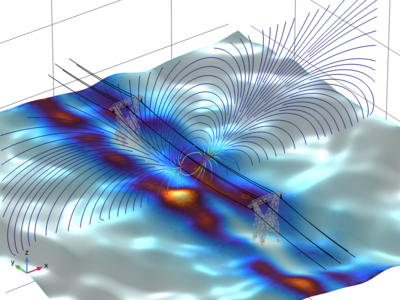
Power lines are commonly used as a means of transmitting electrical power across large distances. In this tutorial, towers transmitting high voltage three-phase AC power are modeled, and the resulting electric field is computed. The towers have two shielding lines. The model also ... En savoir plus
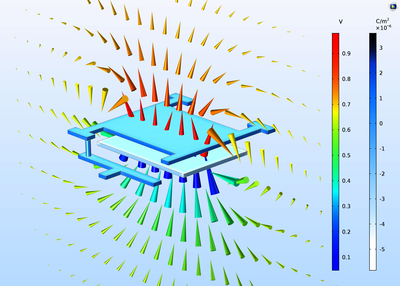
The electrostatically tunable parallel plate capacitor in this example is a typical component in various MEMS devices for radio frequencies that range between 300 MHz and 300 GHz. You can modify the distance between the two plates, as the applied voltage changes, through a spring ... En savoir plus
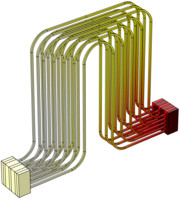
This model simulates a temperature profile in a number of cells and cooling fins in a liquid-cooled battery pack. The model solves in 3D and for an operational point during a load cycle. A full 1D electrochemical model for the lithium battery calculates the average heat source. En savoir plus
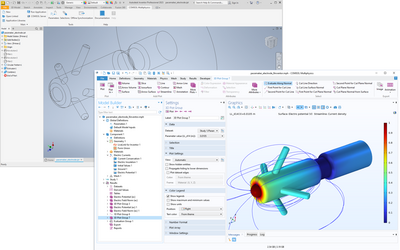
This model, dealing with the current and potential distribution around one pair of electrodes, demonstrates how to synchronize and modify geometry in Inventor® by using the LiveLink™ interface with a parametric sweep. En savoir plus
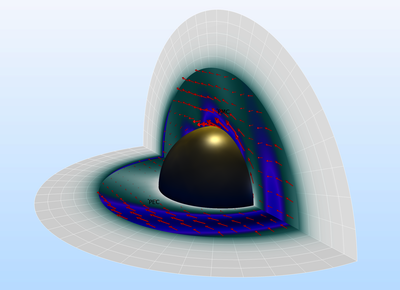
A classic benchmark problem in computational electromagnetics is to solve for the radar cross section (RCS) of a sphere in free space illuminated by a plane wave. This model solves for the RCS of a metallic sphere that has a very high conductivity, which can be treated as a material with ... En savoir plus
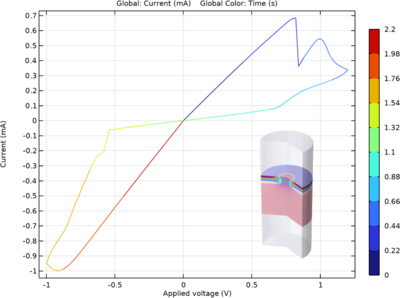
This model captures the dynamic resistive switching behavior of an oxide-based memristor. The device features a thin metal oxide layer sandwiched between two metal electrodes. When a voltage is applied, oxygen vacancies within the oxide layer migrate, acting as charge carriers and ... En savoir plus
A piezoelectric transducer can be used either to transform an electric current to an acoustic pressure field or, the opposite, to produce an electric current from an acoustic field. These devices are generally useful for applications that require the generation of sound in air and ... En savoir plus
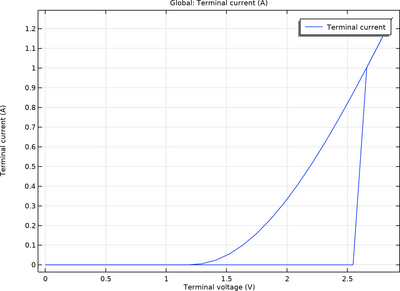
This model shows how to model a simple Shockley diode— a four-layer PNPN semiconductor device. The Shockley diode is also named as thyristor. In this model, the Analytic Doping Model node is utilized to define the doping profiles for each domain. A time-dependent study is employed to ... En savoir plus