
La Bibliothèque d'Applications présente des modèles construits avec COMSOL Multiphysics pour la simulation d'une grande variété d'applications, dans les domaines de l'électromagnétisme, de la mécanique des solides, de la mécanique des fluides et de la chimie. Vous pouvez télécharger ces modèles résolus avec leur documentation détaillée, comprenant les instructions de construction pas-à-pas, et vous en servir comme point de départ de votre travail de simulation. Utilisez l'outil de recherche rapide pour trouver les modèles et applications correspondant à votre domaine d'intérêt. Notez que de nombreux exemples présentés ici sont également accessibles via la Bibliothèques d'Applications intégrée au logiciel COMSOL Multiphysics® et disponible à partir du menu Fichier.
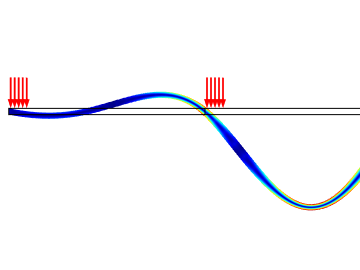
This example shows how to model a load which varies in space and time. A series of load pulses travel along a beam which is supported at equal distances. For some combinations of the traveling speed of the load pulses and the spacing between them, it is possible to excite resonances in ... En savoir plus
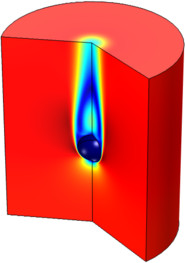
The first stop for polluted water entering a water work is normally a large tank, where large particles are left to settle. Generally, gravity settling is an economical method of separating particles. If the fluid in the tank is moving at a controlled low velocity, the particles can be ... En savoir plus
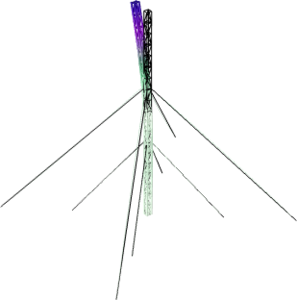
This example shows how to compute the critical buckling load in the presence of dead loads. A truss tower is supported by pretensioned guys. The pretension load and gravity on the truss are considered as dead loads, while the vertical load applied at the top of the tower is considered ... En savoir plus
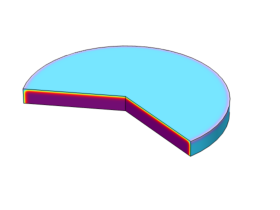
When cooking food, such as a patty, in convection ovens there is a trade off in the heating method. If the patty is heated at a low oven temperature the cooking is slow and the patty dries out, resulting in a poor taste. If the patty is heated rapidly at a high temperature, it is ... En savoir plus
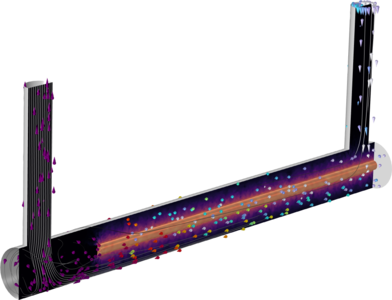
In this example, a simple ultraviolet (UV) water purification reactor is modeled using a combination of ray tracing, computational fluid dynamics, and Lagrangian particle tracking. First, the volumetric fluence rate is accumulated along rays released from the surface of the UV lamp using ... En savoir plus
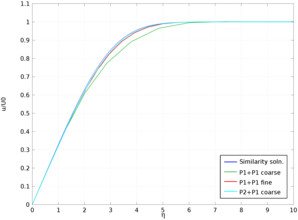
The incompressible boundary layer on a flat plate in the absence of a pressure gradient is usually referred to as the Blasius boundary layer. The steady, laminar boundary layer developing downstream of the leading edge eventually becomes unstable to Tollmien-Schlichting waves and finally ... En savoir plus
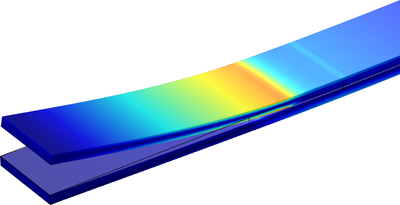
Interfacial failure by delamination or debonding can be simulated with a Cohesive Zone Model (CZM). This example shows the implementation of a CZM with a bilinear traction-separation law. It is used to predict the mixed-mode softening onset and delamination propagation in a composite ... En savoir plus
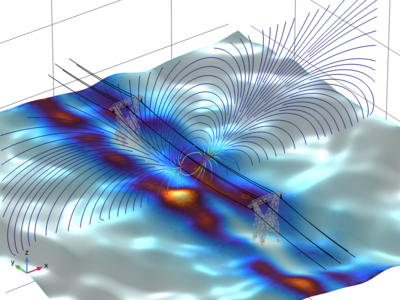
Power lines are commonly used as a means of transmitting electrical power across large distances. In this tutorial, towers transmitting high voltage three-phase AC power are modeled, and the resulting electric field is computed. The towers have two shielding lines. The model also ... En savoir plus


