
La Bibliothèque d'Applications présente des modèles construits avec COMSOL Multiphysics pour la simulation d'une grande variété d'applications, dans les domaines de l'électromagnétisme, de la mécanique des solides, de la mécanique des fluides et de la chimie. Vous pouvez télécharger ces modèles résolus avec leur documentation détaillée, comprenant les instructions de construction pas-à-pas, et vous en servir comme point de départ de votre travail de simulation. Utilisez l'outil de recherche rapide pour trouver les modèles et applications correspondant à votre domaine d'intérêt. Notez que de nombreux exemples présentés ici sont également accessibles via la Bibliothèques d'Applications intégrée au logiciel COMSOL Multiphysics® et disponible à partir du menu Fichier.
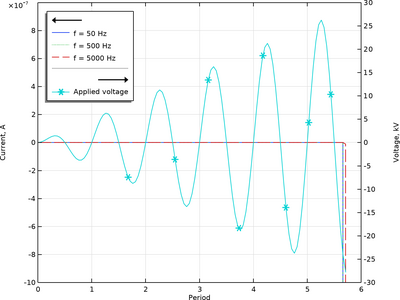
The model estimates the AC breakdown voltage between parallel electrodes in air by simulating charge transport dynamics. To keep computations efficient, it is implemented in one dimension, though it can be adapted for different gases and extended to higher-dimensional setups. The ... En savoir plus
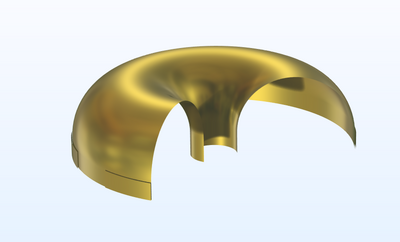
This tutorial demonstrates how to model a gyroscope based on the birdbath resonator gyroscope (BRG) design. The BRG is a type of Coriolis vibratory gyroscope (CVG) invented at the University of Michigan as a navigation-grade gyroscope in the mm-scale. This tutorial shows how the ... En savoir plus
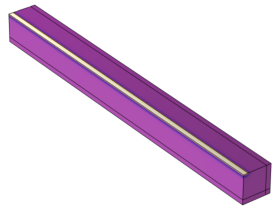
The model demonstrates the basics of the 3-omega method. The coupled electromagnetic heating problem is solved in a solid sample which is heated by a thin copper strip, deposited on the surface of a sample. Analyzing the frequency dependence of the voltage oscillation amplitude, we ... En savoir plus
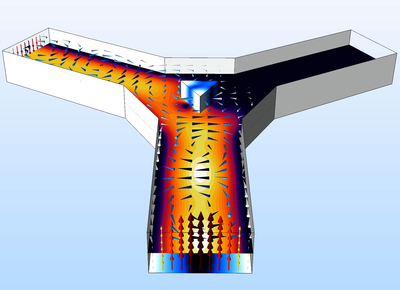
A lossy ferrite circulator at 3GHz is modeled. Geometrical design parameters are varied to match the impedance for minimal reflection of the fundamental TE10 rectangular waveguide mode. En savoir plus
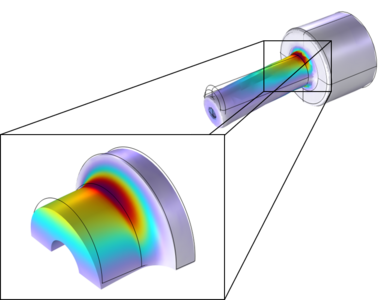
This model shows how to perform a submodeling analysis in order to evaluate structural stress. Using a submodel helps to compute the results in a refined geometry detail while applying loads and constraints in the global model. En savoir plus
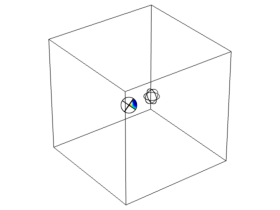
This model verifies that the onset of streamer formation between two spheres separated by atmospheric pressure dry air at a distance of 2cm occurs at 51.8kV. The electrical breakdown is detected by integrating Townsend coefficients along the electric field lines between the two spheres. ... En savoir plus
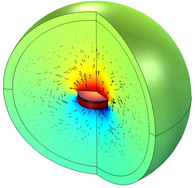
This tutorial shows how you can use the Electromechanics interface in COMSOL's MEMS Module to model Electrostriction. Electrostrictive materials (e.g. PMN-PT) exhibit nonlinear strain as a function of electric field. This 2D axisymmetry model uses a parametric sweep of voltage to ... En savoir plus
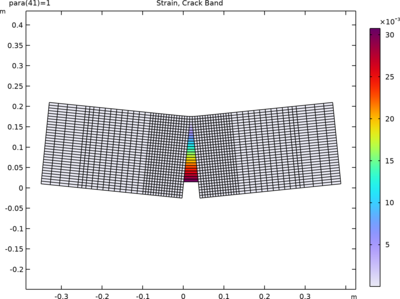
In this example, two model for brittle damage are used to evaluate the fracture of a notched concrete beam subjected to three point bending. The results are compared with experimental data. En savoir plus
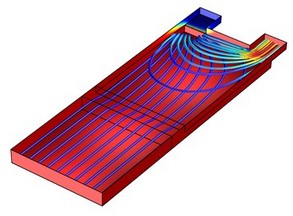
Thermal management has become a critical aspect of today’s electronic systems, which often include many high-performance circuits that dissipate large amounts of heat. Many of these components require efficient cooling to prevent overheating. Some of these components, such as processors, ... En savoir plus
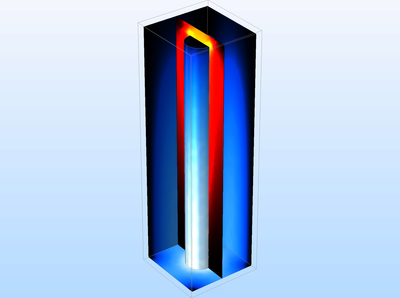
Microwave filters are used to eliminate unwanted frequency components in the output from microwave transmitters. They are typically inserted between a power amplifier and an antenna. The amplifiers are nonlinear and produce harmonics that must be eliminated with filters that have a ... En savoir plus


