
La Bibliothèque d'Applications présente des modèles construits avec COMSOL Multiphysics pour la simulation d'une grande variété d'applications, dans les domaines de l'électromagnétisme, de la mécanique des solides, de la mécanique des fluides et de la chimie. Vous pouvez télécharger ces modèles résolus avec leur documentation détaillée, comprenant les instructions de construction pas-à-pas, et vous en servir comme point de départ de votre travail de simulation. Utilisez l'outil de recherche rapide pour trouver les modèles et applications correspondant à votre domaine d'intérêt. Notez que de nombreux exemples présentés ici sont également accessibles via la Bibliothèques d'Applications intégrée au logiciel COMSOL Multiphysics® et disponible à partir du menu Fichier.
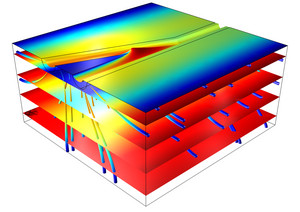
Multilateral wells—those with multiple legs that branch off from a single well—can produce oil efficiently because the legs can tap multiple productive zones and navigate around impermeable ones. Unfortunately, drilling engineers must often mechanically stabilize multilateral wells with ... En savoir plus
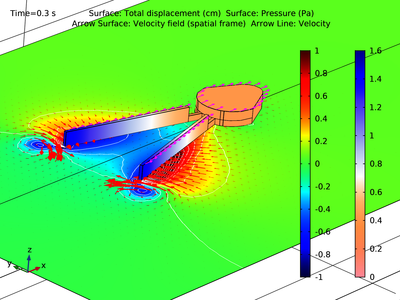
This example illustrates the modeling of a multibody mechanism submerged in a fluid. The mechanism consists of two fins connected to a central rigid body through hinge joints. A transient fluid–structure interaction analysis is performed to simulate the swimming behavior of the ... En savoir plus
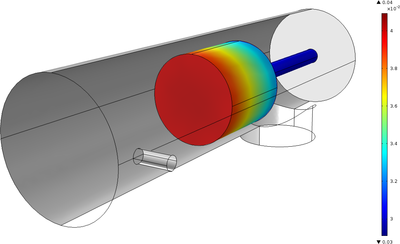
Chemical vapor deposition (CVD) is a process often used in the semiconductor industry to grow layers of high-purity solid material on top of a wafer substrate. CVD is achieved using many different techniques and across a range of pressures from atmospheric to ultrahigh vacuum (UHV/CVD). ... En savoir plus

This model shows how to build and solve a radiative heat transfer problem using the Heat Transfer interface. In particular, this 2D model illustrates the use of the surface-to-surface radiation feature. In this model, three surfaces form a cavity. Heat flux is set at two outer ... En savoir plus
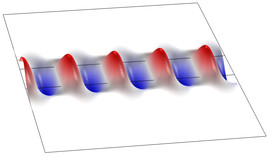
A planar dielectric slab waveguide demonstrates the principles behind any kind of dielectric waveguide such as a ridge waveguide or a step-index fiber. This model solves for the effective index and fields of a dielectric slab waveguide and compares the solution to analytic results. En savoir plus
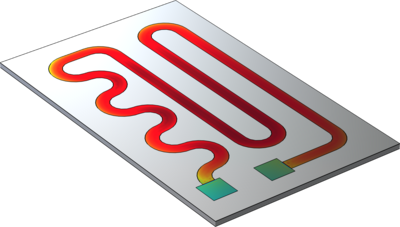
Small heating circuits find use in many applications. For example, in manufacturing processes, they heat up reactive fluids. The device in this tutorial consists of an electrically resistive layer deposited on a glass plate. The layer results in Joule heating when a voltage is applied to ... En savoir plus
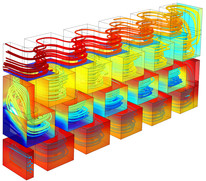
Plate reactors running under continuous conditions have emerged as candidates to replace batch reactors, primarily in fine chemicals and pharmaceuticals production. One of the advantages of the plate reactor design is that it allows for efficient temperature control of the reacting ... En savoir plus
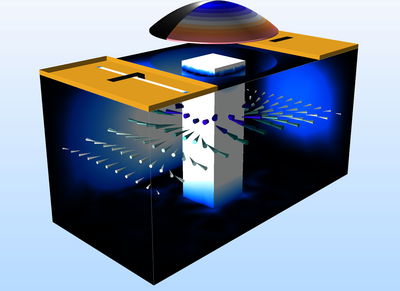
An evanescent mode cavity filter can be realized by adding a structure inside of the cavity. This structure changes the resonant frequency lower than the dominant mode of the unfilled cavity. A piezo actuator is used to control the size of a small air gap which provides the tunability of ... En savoir plus
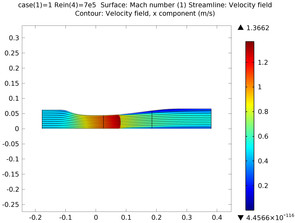
In this model the high speed turbulent gas flow in a converging and diverging nozzle is modeled using the High Mach Number Flow interface. The diffuser is transonic in the sense that the flow at the inlet is subsonic, but due to the contraction and the low outlet pressure, the flow ... En savoir plus
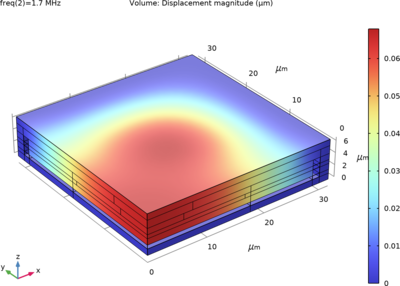
A capacitive micromachined ultrasonic transducer (CMUT) is a micro-scale receiver that converts ultrasound to electrical signal for high-resolution imaging application. This CMUT design has optimized force-displacement characteristics for increased transduction efficiency. Central to the ... En savoir plus


