
La Bibliothèque d'Applications présente des modèles construits avec COMSOL Multiphysics pour la simulation d'une grande variété d'applications, dans les domaines de l'électromagnétisme, de la mécanique des solides, de la mécanique des fluides et de la chimie. Vous pouvez télécharger ces modèles résolus avec leur documentation détaillée, comprenant les instructions de construction pas-à-pas, et vous en servir comme point de départ de votre travail de simulation. Utilisez l'outil de recherche rapide pour trouver les modèles et applications correspondant à votre domaine d'intérêt. Notez que de nombreux exemples présentés ici sont également accessibles via la Bibliothèques d'Applications intégrée au logiciel COMSOL Multiphysics® et disponible à partir du menu Fichier.
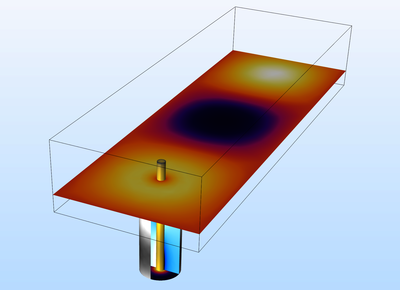
Feeding a waveguide from a coaxial cable is a straightforward way to achieve electromagnetic waves inside a waveguide. Due to its small size and circular shape, the cable contributes significantly to the overall size of the problem. It is therefore necessary to keep the cable as short as ... En savoir plus

This example builds surrogate models with deep neural network (DNN) training to quickly estimate the performance of a microstrip patch antenna based on four design parameters: patch length, tuning stub length, dielectric constant of a substrate, and frequency. The model also simulates a ... En savoir plus
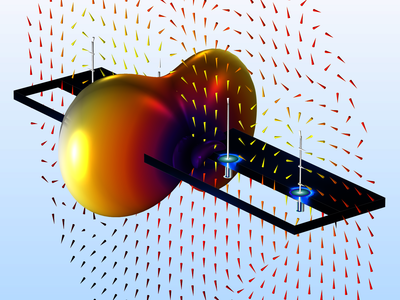
It is possible to shape the radiation pattern and steer the beam from an antenna array by controlling the relative phases and magnitudes of the input signal. This example shows how to design an active electronically scanned array (AESA) using arithmetic phase progression on each antenna ... En savoir plus
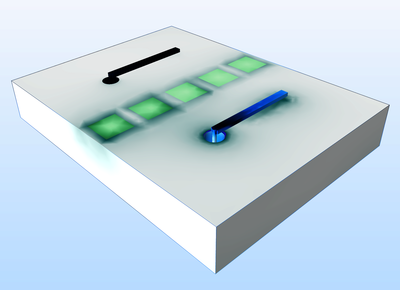
An Electromagnetic Band Gap (EBG) structure can be used to increase the isolation between antennas close to each other. The decoupling effect is not only a function of frequency but also polarization and coupling-plane configuration. When designing an EBG structure, one needs to make ... En savoir plus
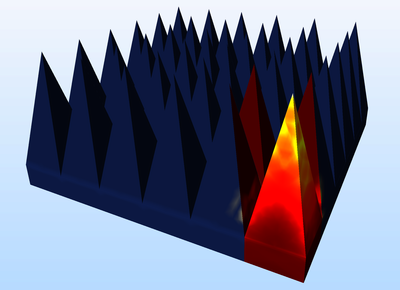
In this model, a microwave absorber is constructed from an infinite 2D array of pyramidal lossy structures. Pyramidal absorbers with radiation-absorbent material (RAM) are commonly used in anechoic chambers for electromagnetic wave measurements. Microwave absorption is modeled using a ... En savoir plus
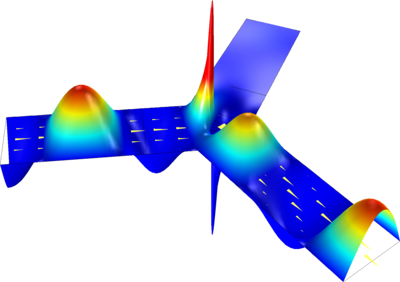
A microwave circulator is a multiport device in which a wave incident on Port 1 is coupled only into Port 2; a wave incident on Port 2 is coupled only into Port 3; and so on. Circulators are used to isolate microwave components, for example, to couple a transmitter and a receiver to a ... En savoir plus
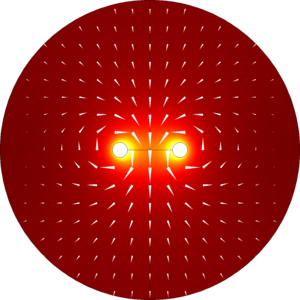
A parallel wire transmission line is composed of two conducting wires in a dielectric such as air. The fields around such a transmission line are not directly confined by the conductors, and extend to infinity, although they drop off in rapidly away from the wires. This model ... En savoir plus
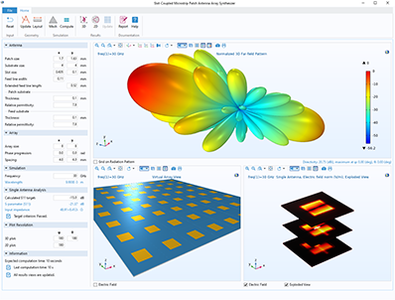
This app demonstrates the following: Parameterized geometries Visualizing material appearance, color, and texture Multiple plots in the same window to visualize the results Options to visualize the results with different views using check boxes Microstrip patch antenna arrays are ... En savoir plus
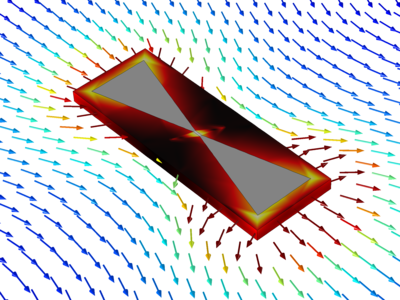
A bow-tie antenna patterned on a dielectric substrate is optimized by adjusting the length of the arms and the flare angle to reduce the magnitude of S11, reflection coefficient. The two geometric dimensions used as design variables directly control the antenna's size and shape, and also ... En savoir plus
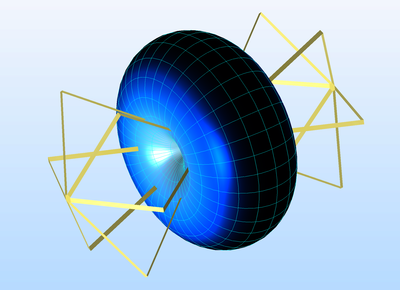
Biconical antennas are popular for very high frequency (VHF) measurement because they support a wide frequency range. They are also useful for electromagnetic compatibility (EMC) testing where the antenna can be used as an RF source in susceptibility or immunity test. This model ... En savoir plus


