
La Bibliothèque d'Applications présente des modèles construits avec COMSOL Multiphysics pour la simulation d'une grande variété d'applications, dans les domaines de l'électromagnétisme, de la mécanique des solides, de la mécanique des fluides et de la chimie. Vous pouvez télécharger ces modèles résolus avec leur documentation détaillée, comprenant les instructions de construction pas-à-pas, et vous en servir comme point de départ de votre travail de simulation. Utilisez l'outil de recherche rapide pour trouver les modèles et applications correspondant à votre domaine d'intérêt. Notez que de nombreux exemples présentés ici sont également accessibles via la Bibliothèques d'Applications intégrée au logiciel COMSOL Multiphysics® et disponible à partir du menu Fichier.

When high-fidelity measurement microphones are calibrated, a pressure reciprocity calibration method is used. During calibration, two microphones are connected at each end of a closed cylindrical cavity. For the calibration procedure, it is important to understand the acoustic field ... En savoir plus
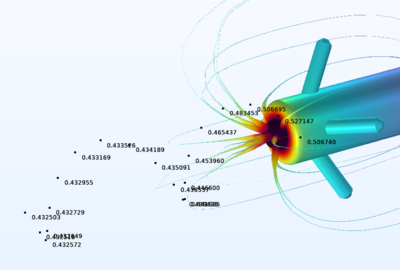
This model demonstrates how to use the chatbot functionality in COMSOL Multiphysics® to add annotations to a model of a pacemaker electrode. To learn more about this model, see our accompanying blog post “Using the Chatbot Window in COMSOL Multiphysics®”. En savoir plus
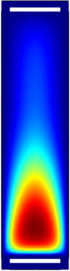
DC glow discharges in the low-pressure regime have long been used for gas lasers and fluorescent lamps. DC discharges are attractive to study because the solution is time independent. The 1D and 2D models show how to use the DC Discharge interface to set up an analysis of a positive ... En savoir plus
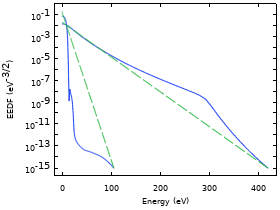
This tutorial models a DC glow discharge by solving fluid-type plasma equations fully coupled with the homogeneous and time-independent electron Boltzmann equation in the classical two-term approximation. The approximated Boltzmann equation is solved for each position of space and is ... En savoir plus
In fuel cell power generators, a steam reformer unit typically produces the hydrogen needed for the cell stack. This example illustrates the modeling of a steam reformer. The reformation chemistry occurs in a porous catalytic bed where energy is supplied through heating tubes to drive ... En savoir plus

The Bessel panel is a way to arrange a number of loudspeakers so that the angular sound distribution resembles that of a single speaker. This model combines five Bessel panels in the same pattern to approximate a purely radial sound field. The speakers are driven with different ... En savoir plus
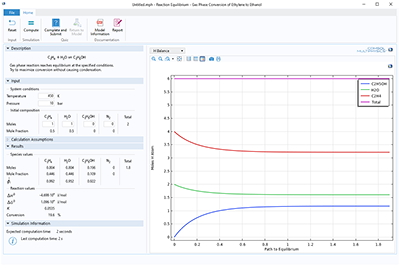
This app demonstrates the following: How an app can be used as a teaching tool An 8 question multiple choice quiz where the answers can be sent to the grader by email This app calculates the equilibrium compositions in gas phase conversion of ethylene to ethanol. It allows you to ... En savoir plus
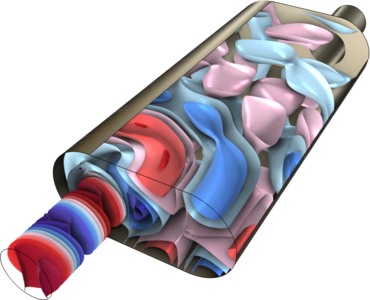
This example describes the pressure wave propagation in a muffler for an internal combustion engine. This example shows how to analyze both inductive and resistive damping in a muffler as well as the use of port boundary conditions. En savoir plus
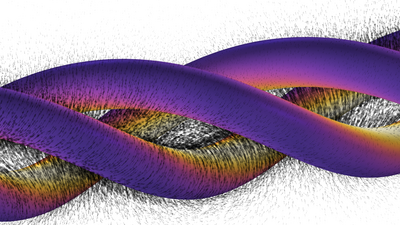
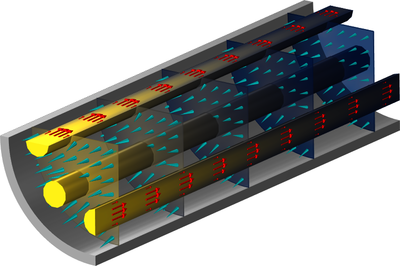
These models demonstrate various ways of exciting magnetic fields using the Magnetic Field Formulation interface in the AC/DC Module, an add-on to the COMSOL Multiphysics® software. To learn more about these models, see the accompanying blog post “Modeling of Excitations with ... En savoir plus
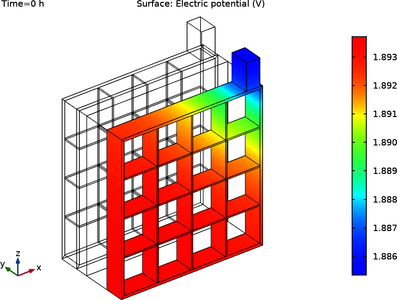
This 3D model example demonstrates the use of the Lead-Acid Battery interface for modeling current distribution in full cell employing a lead-acid battery chemistry. The lead acid battery chemistry uses PbO2 as the positive porous electrode and Pb as the negative porous electrode and ... En savoir plus


