
La Bibliothèque d'Applications présente des modèles construits avec COMSOL Multiphysics pour la simulation d'une grande variété d'applications, dans les domaines de l'électromagnétisme, de la mécanique des solides, de la mécanique des fluides et de la chimie. Vous pouvez télécharger ces modèles résolus avec leur documentation détaillée, comprenant les instructions de construction pas-à-pas, et vous en servir comme point de départ de votre travail de simulation. Utilisez l'outil de recherche rapide pour trouver les modèles et applications correspondant à votre domaine d'intérêt. Notez que de nombreux exemples présentés ici sont également accessibles via la Bibliothèques d'Applications intégrée au logiciel COMSOL Multiphysics® et disponible à partir du menu Fichier.

This tutorial demonstrates the operation of a gyroscope based on design provided by Dr. James Ransley at Veryst Engineering, LLC. The model uses the Electromechanics coupling with the mixed finite element formulation in the Electrostatics interface. En savoir plus
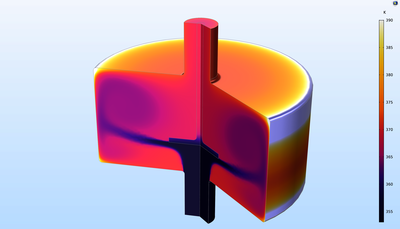
The engine block of a car includes a cooling jacket to remove excess heat from combustion. The cooling jacket consists of open spaces in the cylinder block and the cylinder head. When the engine is running, a coolant fluid is pumped through the jacket to keep the engine from overheating. ... En savoir plus
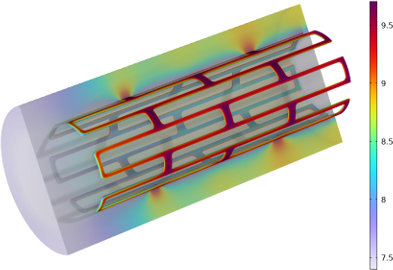
Biodegradable metallic biomaterials such as Magnesium (Mg) are gathering attention for biomedical applications due to their favorable properties. The present model simulates dissolution of a Mg stent in a blood vessel. Due to the circumferential symmetry, only one-twelfth of the actual ... En savoir plus
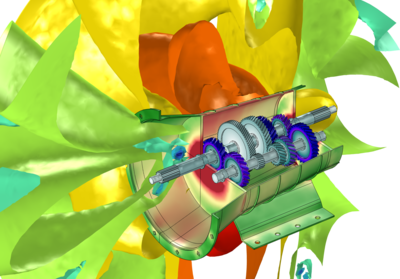
This example illustrates the modeling of vibration and noise in a 5-speed synchromesh gearbox of a manual transmission vehicle. A transient multibody analysis is performed to compute the gearbox vibration for the specified engine speed and external load. The normal acceleration of the ... En savoir plus
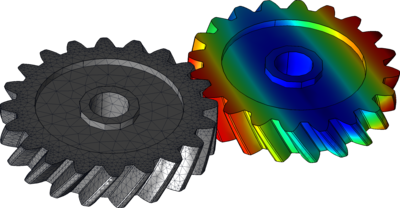
This model illustrates the dynamics of helical gears. It is built using the gears functionality in the Multibody Dynamics interface in COMSOL Multiphysics. A transient study is performed to analyze the effect of constant gear mesh stiffness, varying gear mesh stiffness, and the ... En savoir plus
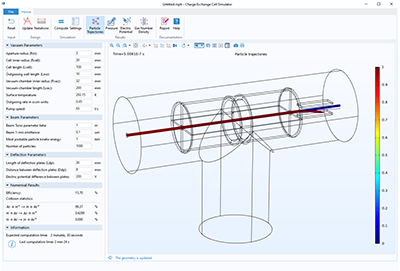
A charge exchange cell consists of a region of gas at an elevated pressure within a vacuum chamber. When an ion beam interacts with the higher-density gas, the ions undergo charge exchange reactions with the gas which then create energetic neutral particles. It is likely that only a ... En savoir plus
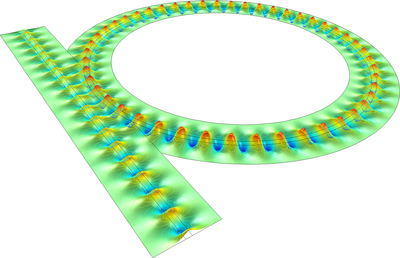
In its simplest form, an optical ring resonator consists of a straight waveguide and a ring waveguide. The waveguides are placed close to each other, making the light affect each between the two structures. If the propagation length around the ring is an integral number of wavelengths, ... En savoir plus
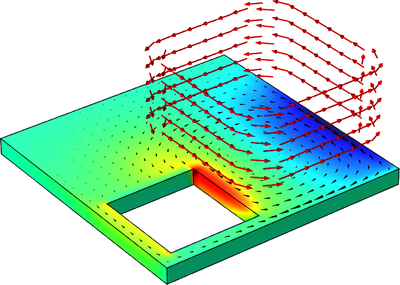
This model solves the Testing Electromagnetic Analysis Methods (TEAM) problem 7, “Asymmetrical Conductor with a Hole”—a benchmark problem concerning the calculation of eddy currents and magnetic fields produced when an aluminum conductor is placed asymmetrically above a multi-turn coil ... En savoir plus


